By- Junrey J Moncada – Pastor of Berea Baptist Church
Prk.Sabang, Caburan Big, Jose Abad Santos, Davao Occidental.
A response to Brother Robin Compston – Metropolitan Tabernacle, London, UK.
To Brother Robin,
With my utmost respect, I sincerely thank you for sharing your arguments, which I recognize are the same points you raised during our recent Zoom meeting in our exchange of thoughts concerning Landmarkism. As I seek to address the matters you have presented, I kindly ask for your understanding, dear brother, should any of my words seem sharp. Please know it is not my intention to offend you personally, but only to address the ideas discussed and to give clearer emphasis to my point.
I am a Landmark Baptist not because of J. R. Graves’ writings, nor because of the works of other Landmark Baptist theologians—though I have read and benefited from their books. Rather, I am a Landmark Baptist by conviction, grounded in the truth revealed in the Scriptures and in the historical testimony of churches that remained free from the influence of the Roman Catholic Church and her daughters, the Protestant denominations.
Before addressing the arguments and offering my responses, I would like first to present a concise view of Landmarkism as I understand it from a biblical perspective.
Core Views of Landmarkism
- The Perpetuity of Christ’s Church – As Christ Himself promised in Matthew 16:18 and 28:20, His church will continue until the end of the age.
- The Continuity of Christ’s Teachings and Practices – Christ commanded His church in Matthew 28:18–20 to observe all that He taught. The Holy Spirit preserves these teachings and brings them to remembrance (John 14:26). This is the faith once delivered to the saints (Jude 3), made known through the church (Eph. 3:10; 1 Tim. 3:15), and faithfully passed on from one generation to another (2 Tim. 2:2).
- The Local, Visible Church – Christ addressed, commended, warned, and rebuked specific congregations through His messages to the seven churches of Asia Minor (Rev. 1:1, 20), affirming the primacy of the local and visible assembly.
- The Bride of Christ – The church is presented as a chaste virgin espoused to Christ (2 Cor. 11:2), cleansed and sanctified by His word (Eph. 5:26–27), and kept pure for Him.
- Biblical Authority to Preach and Baptize – In obedience to the Great Commission (Matt. 28:19–20; John 20:21), the authority to proclaim the gospel and administer baptism is entrusted to the church, which continues the pattern set forth in Scripture (Rom. 6:3–4; 10:14–15).
I am going to present my counter arguments point by point.
1-The confessions:
Prior to J.R Graves, Principles of Landmarkism were long before taught on the pulpit of the falsely called Brownists, True Confession of 1596, The Anabaptist Mennonite Confession of 1632 and the 1st London Baptist Confession of Particular Baptist in 1644.
-The True Confession (1596) was the work of an English-Separatist congregation of Baptists in exile in Amsterdam. This excerpt is from William L. Lumpkins, Baptist Confessions of Faith, revised ed. (Valley Forge, PA: Judson, 1969). The spelling was updated where necessary.
A TRUE CONFESSION OF THE FAITH, AND HUMBLE ACKNOWLEDGMENT OF THE ALLEGIANCE, which we her Majesty’s Subjects, falsely called Brownists, do hold towards God, and yield to her Majesty and all other that are over us in the Lord. Set down in Articles or Positions, for the better and more easy understanding of those that shall read it. And published for the clearing of ourselves from those unchristian slanders of heresy, schism, pride, obstinate, disloyalty, sedition, etc. which by our adversaries are in all places given out against us.
Article 17
That in the meantime, besides his absolute rule in the world, Christ hath here in earth a spiritual Kingdom and canonical regiment in his Church over his servants, which Church he hath purchased and redeemed to himself, as a peculiar inheritance (notwithstanding many hypocrites do for the time lurk amongest them), calling and winning them by the power of his word unto the faith, separating them from amongst unbelievers, from idolatry, false worship, superstition, vanity, dissolute life, and works of darkness, etc.; making them a royal Priesthood, an holy Nation, a people set at liberty to shew forth the virtues of him that hath called them out of darkness into his marvelous light, gathering and uniting them together as members of one body in his faith, love and holy order, unto all general and mutual duties, entrusting and governing them by such officers and laws as he hath prescribed in his word; by which Officers and laws he governeth his Church, and by none other.
Article 18
That to this Church he hath made the promises, and given the seals of his Covenant, presence, love, blessing and protection. Here are the holy Oracles as in the side of the Ark, surely kept and purely taught. Here are all the fountains and springs of his grace continually replenished and flowing forth. Here is He lifted up to all Nations, hither He uniteth all men to his supper, his manage feast; hither ought all men of all estates and degrees that acknowledge him their Prophet, Priest and King to repair, to be enrolled amongst his household servants, to be under his heavenly conduct and government, to lead their lives in his walled sheepfold and watered orchard, to have communion here with the Saints, that they may be made meet to be partakers of their inheritance in the kingdom of God.
-The Dordrecht Confession of Faith Adopted April 21, 1632, by a Dutch Mennonite Conference held at Dordrecht, Holland.
Article VIII. Of the Church of Christ – We believe in, and confess a visible church of God, namely, those who, as has been said before, truly repent and believe, and are rightly baptized; who are one with God in heaven, and rightly incorporated into the communion of the saints here on earth. These we confess to be the chosen generation, the royal priesthood, the holy nation, who are declared to be the bride and wife of Christ, yea, children and heirs of everlasting life, a tent, tabernacle, and habitation of God in the Spirit, built upon the foundation of the apostles and prophets, of which Jesus Christ Himself is declared to be the cornerstone (upon which His church is built). This church of the living God, which He has acquired, purchased, and redeemed with His own precious blood; with which, according to His promise, He will be and remain always, even unto the end of the world, for consolation and protection, yea, will dwell and walk among them, and preserve them, so that no floods or tempests, nay, not even the gates of hell, shall move or prevail against them-this church, we say, may be known by their Scriptural faith, doctrine, love, and godly conversation, as, also, by the fruitful observance, practice, and maintenance of the true ordinances of Christ, which He so highly enjoined upon His disciples. I Cor. 12; I Pet. 2.9; John 3.29; Rev. 19.7; Titus 3:6, 7; Eph. 2:19-21; Matt. 16.18; I Pet. 1.18, 19; Matt. 28.20; II Cor. 6:16; Matt. 7:25.
-First London Baptist Confession of 1644- 1st edition
-A CONFESSION OF FAITH of seven congregations or churches of Christ in London, which are commonly, but unjustly, called Anabaptists; published for the vindication of the truth and information of the ignorant; likewise for the taking off those aspersions which are frequently, both in pulpit and print, unjustly cast upon them. Printed in London, Anno 1646. But this I confesse unto thee, that after the way which they call heresie so worship I the God of my Fathers, beleeving all things that are written in the Law and the Prophets, and have hope towards God, which they themselves also allow, that there shall be a resurrection of the dead both of the just and unjust. – Acts xxiv. 14, 15. For we cannot but speak the things that we have seen and heard. – Acts iv. 20. If I have spoken evill, bear witnesse of the evill; but if well, why smitest thou me? – John xviii. 23. Blessed are yee when men revile you, and say all manner of evil against you falsly for my sake. Rejoice, etc. – Matth. v.11, 12. & xix. 29.
Article XXXIII. -That Christ has here on earth a spiritual Kingdom, which is the Church, which He has purchased and redeemed to Himself, as a particular inheritance: which Church, as it is visible to us, is a company of visible (1 Cor. 1:1; Eph. 1:1) saints, (Rom. 1:1; Acts 26:18; 1 Thes. 1:9; 2 Cor. 6:17; Rev. 18:18) called and separated from the world, by the Word and the (Acts 2:37 with Acts 10:37) Spirit of God, to the visible profession of the faith of the Gospel, being baptized into the faith, and joined to the Lord, and each other, by mutual agreement, in the practical enjoyment of the (Rom. 10:10; Acts 2:42; 20:21; Mat. 18:19, 20; 1 Peter 2:5) ordinances, commanded by Christ their head and King.
-First London Baptist Confession 1646- 2nd edition
-The first edition was published in 1644. This second edition “corrected and enlarged” was originally published in 1646. A confession of faith of seven congregations or churches of Christ in London, which are commonly, but unjustly called Anabaptists; published for the vindication of the truth and information of the ignorant; likewise for the taking off those aspersions which are frequently, both in pulpit and print, unjustly cast upon them. Printed at London, Anno 1646.
Article XXXIII.-Jesus Christ hath here on earth a [manifestation of His] spiritual kingdom, which is His Church, whom He hath purchased and redeemed to Himself as a peculiar inheritance; which Church is a company of visible saints, called and separated from the world by the word and Spirit of God, to the visible profession of faith of the gospel, being baptized into that faith, and joined to the Lord, and each other, by mutual agreement in the practical enjoyment of the ordinances commanded by Christ their head and king. Matt. 11:11; 2 Thess. 1:1; 1 Cor. 1:2; Eph. 1:1; Rom. 1:7; Acts 19:8,9, 26:18; 2 Cor. 6:17; Rev. 18:4; Acts 2:37, 10:37; Rom. 10:10; Matt. 18:19,20; Acts 2:42, 9:26; 1 Pet. 2:5.
Your argument:
To claim that the 1st London Baptist Confession teaches only the local church, while the 2nd London Baptist Confession teaches the invisible universal church as well as the local church is to misunderstand the 1st London Baptist Confession. The phrase ‘as it is visible to us’ is an acknowledgement that there is a different sense in which it is not visible, otherwise it does not need to be said. ‘As it is visible’ it is ‘a company of visible Saints’. That does not mean that there is no invisible church. It is implied that there is also something which is not visible.
My response :
Actually, the clause “as it is visible to us” in the 1st London Baptist Confession of 1644 doesn’t imply an invisible second entity kind of a church. It only appear to them, “to us”, that the church is visible in its kind and in existence to them, that is very clear on how they set forth the context of a visible company of saints, a visible profession of faith in the Gospel, and the visible observance of the ordinances. As a matter of fact, the seven churches who released this confession expanded and clarified their confession by releasing a second edition in 1646.
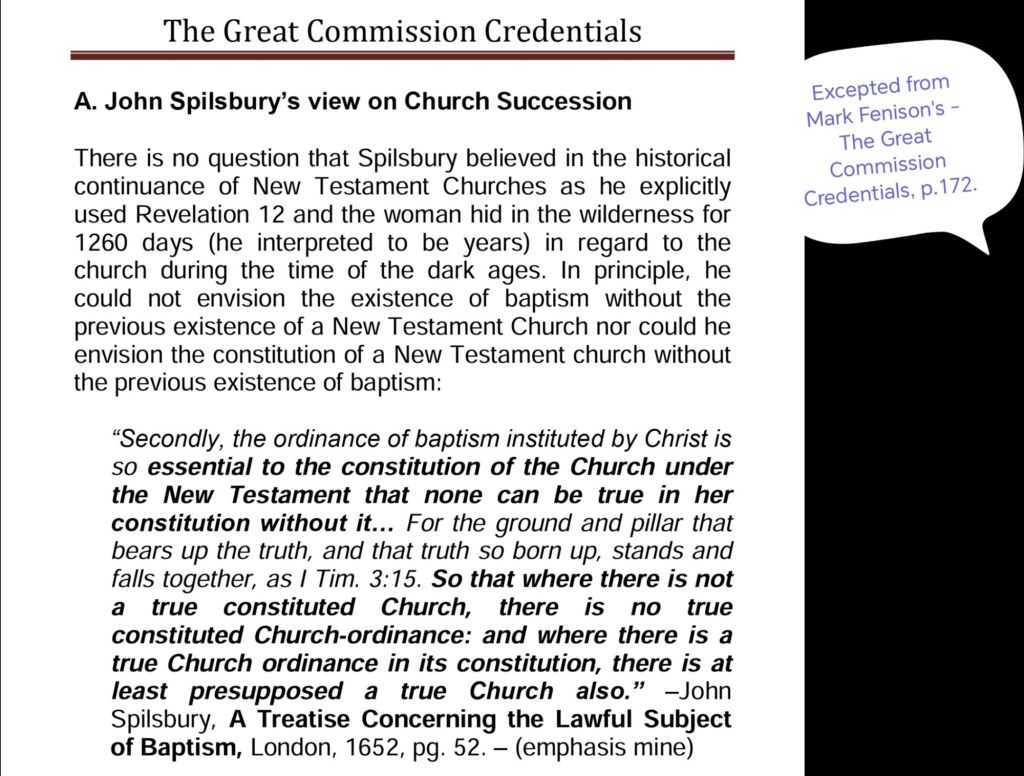
John Spilbury, one of the seven represetatives of the seven Baptist churches in England, who signed the confession, was known for his belief in the local visible kind of church who administered the visible ordinance of the church: cited from his book “God’s Ordinance, the Saints privilege”
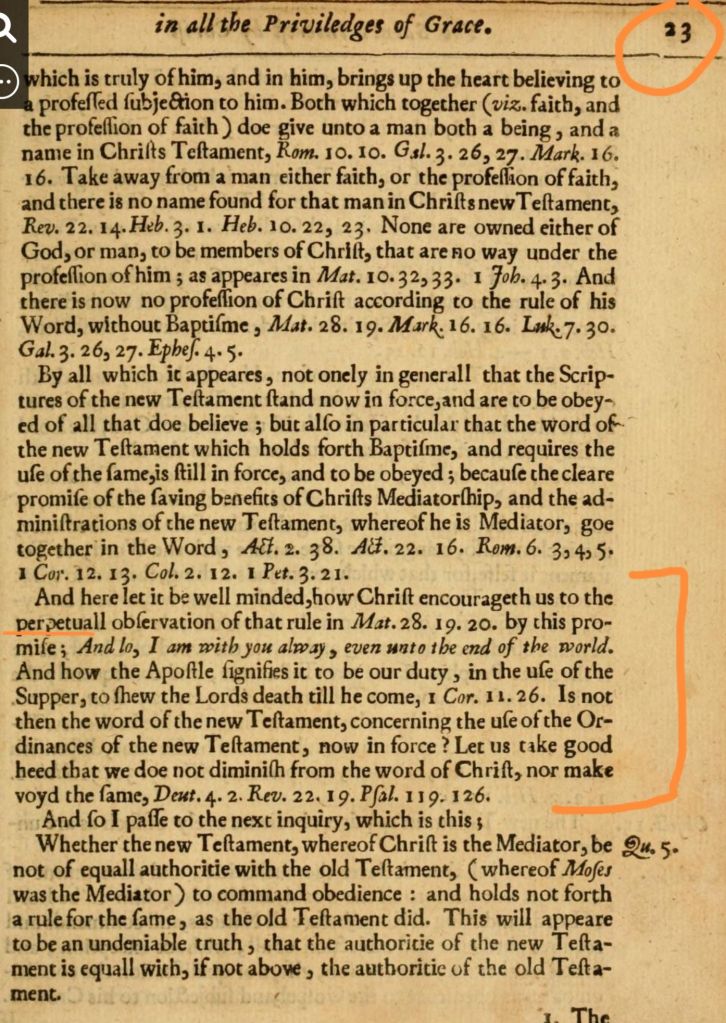
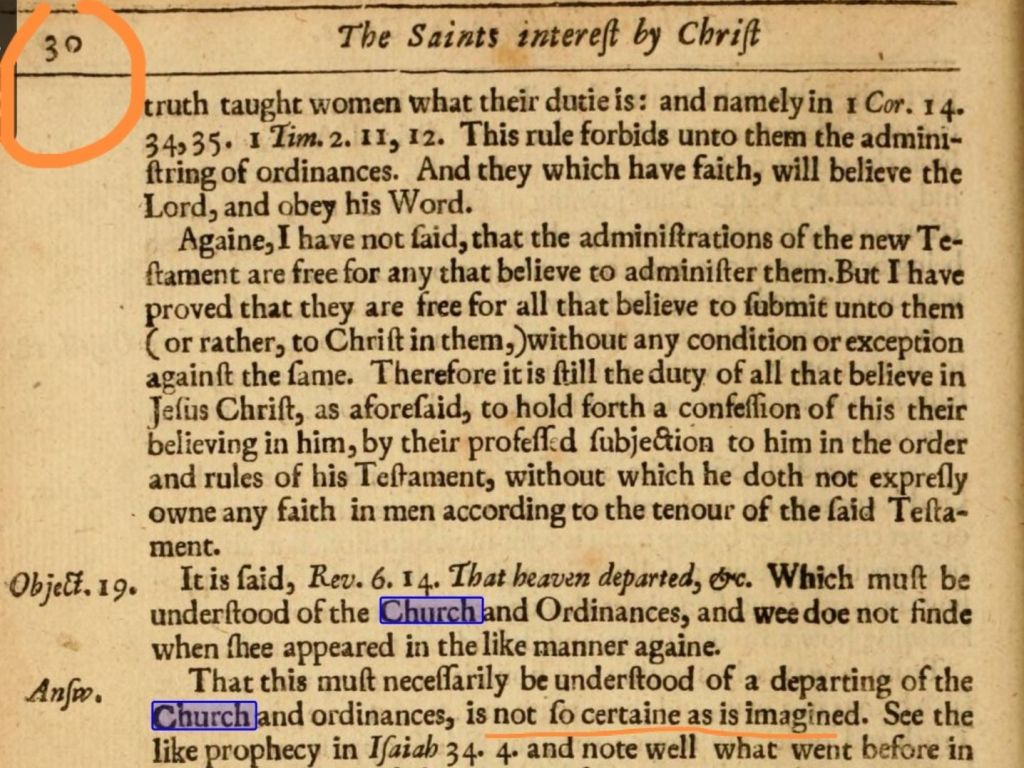
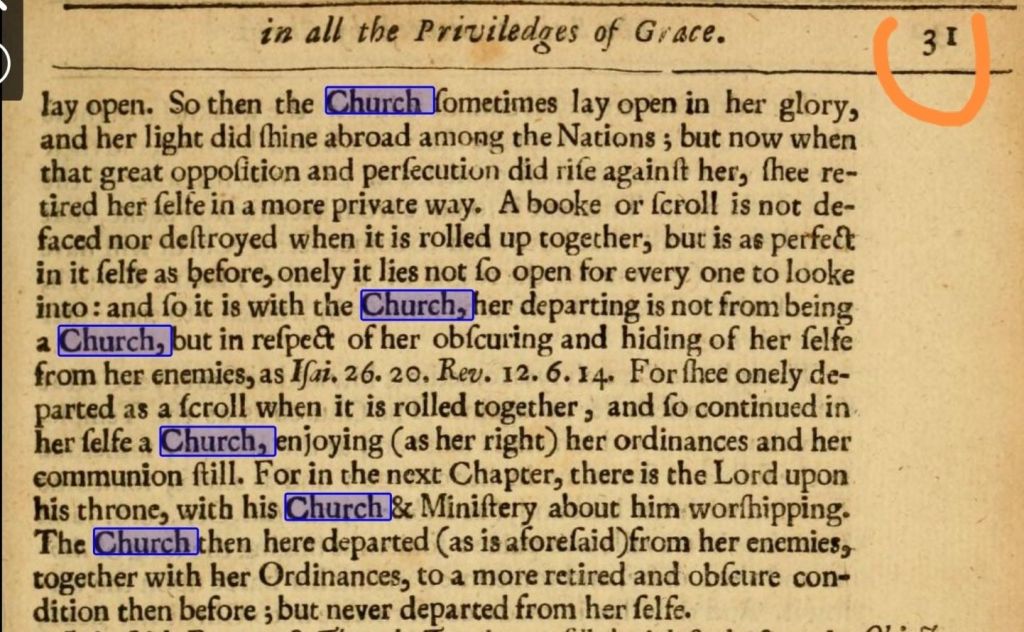
If John Spilsbury and the other signers of the First London Baptist Confession truly believed in a universal, invisible church, then why did they so strongly contend for the local church’s biblical authority in the administration of proper baptism and the Lord’s Supper? For if they held that all forms of baptism and communion were acceptable within a so-called universal church, there would be no need to emphasize such strict adherence to these ordinances within the local assembly. I trust you can see the inconsistency here, even before addressing other points. From my perspective, it is evident that these early Baptists were, in principle, Landmark in their convictions long before the days of J. R. Graves.
History demonstrates that the Second London Baptist Confession, particularly in its statement regarding a universal, invisible church, was influenced by the Westminster Confession of the Presbyterians. A careful comparison of the two reveals striking similarities in language and thought, showing how the latter shaped the former.
Westminster confession
XXV. Of the Church
I. The catholic or universal Church, which is invisible, consists of the whole number of the elect, that have been, are, or shall be gathered into one, under Christ the head thereof; and is the spouse, the body, the fulness of him that filleth all in all.
Second London Baptist Confession -1689
Chapter 26: Of the Church 1.-The catholic or universal church, which (with respect to the internal work of the Spirit and truth of grace) may be called invisible, consists of the whole number of the elect, that have been, are, or shall be gathered into one, under Christ, the head thereof; and is the spouse, the body, the fulness of him that filleth all in all. ( Hebrews 12:23; Colossians 1:18; Ephesians 1:10, 22, 23; Ephesians 5:23, 27, 32 )
I got some citations on the reasons behind the adaptation of the universal invisible church of the 2nd London Baptist Confession of 1689:
“The First London Baptist Confession was drawn up to distinguish the newly organized Calvinistic (Particular) Baptists from both the Arminian (General) Baptists and the continental Anabaptists.The better known ” Second London Confession,” published anonymously in 1677, was republished in 1689 with endorsement upon the issuance of the Act of Toleration when William and Mary assumed England’s throne. This Second Baptist Confession of 1689 is basically a re-statement of the Westminster Confession with only the minor changes necessary to reflect the distinctives in baptism.(https://www.theopedia.com/first-london-baptist-confession)
“The 1677 Confession The result was that, with the restoration of the Monarchy, English Baptists everywhere were suffering persecution for their faith. In 1677 a much larger group of Particular Baptists met together for the purpose of creating a more detailed confession of faith. The process was modelled on the Westminster Confession, which was being used by many Particular Baptist churches despite the differences in church government and mode of baptism.” (https://www.theopedia.com/london-baptist-confession-of-1689).
“In the autumn of 1658 a meeting of representatives of 120 Congregational Churches assembled in the Savoy Palace in London. The proceedings opened with a discussion as to whether to amend the Westminster Confession or to produce a new one. The former course was agreed and the work handed to a committee consisting of Thomas Goodwin, John Owen, Philip Nye, William Bridge, Joseph Caryl and William Greenhill. With the exception of John Owen all of these men had been members of the Westminster Assembly. The revised confession or Declaration of Faith and Order as it was to be called was unanimously approved by the whole Synod which adjourned on 12th October after 12 working days. Thomas Goodwin was commissioned to present a copy to Richard Cromwell, the Lord Protector.[12]
Most of the material in the Savoy Declaration follows the Westminster Confession. There are however a few differences. In chapters 8 and 11 the vicarious nature of Christ’s sacrifice is stated more strongly in Savoy; the 15th chapter on repentance is rewritten entirely. A completely new chapter on the Gospel and its gracious extent is added and becomes chapter 20 – it is a mistake to suppose that this chapter was added by the Baptists in 1677. Toleration in matters non-essential is taught in chapter 24. The chapter on the Church looked forward to the latter days, when ‘antichrist being destroyed, the Jews called, and the adversaries of his dear Son broken, the churches of Christ being enlarged, and edified through a free and plentiful communication of light and grace, shall enjoy in this world a more quiet, peaceable and glorious condition than they have enjoyed’.
After chapter 32 there is a long section of 30 paragraphs on the congregational order of churches. This teaches the independence of local churches, arguing that under Christ all church power is invested in the local church which is able to carry out all acts of church authority including the discipline of members and the calling and ordination of ministers. It recognised the calling of synods to deal with differences between churches and to consider matters of common concern. Such synods have no church power or authority over the separate churches. It was the Westminster Confession as modified by the Savoy Declaration which was to underlie the Second London Confession of the English Baptists.” (https://reformation-today.org/articles-of-interest/455/).
2- The Term
Your Argument:
It is not useful to say that the Bible nowhere uses the terms invisible or universal. That is obviously true, but doesn’t help resolve the issue. The Bible does not use the term Trinity, and yet all orthodox believers accept that term, and find it helpful in defining clearly what they believe. The term ‘local church’ does not occur in the Bible either, but it certainly helps to clarify what is frequently meant when that term is used.
-The word church in Greek is ekklesia. This is formed from 2 words in Greek, the preposition ek meaning ‘out’, and the verb kaleo meaning ‘to call’. The church consists of those who are called out. What are they called out of? They are called out of the world. Who calls them out? God calls them out. When does he call them out? Not when they are recognised by the local church in baptism, but before that when the Spirit calls them at the new birth. At that time they do not belong to any local church, but they belong to the invisible universal church of Christ. The word ekklesia is translated three times in the New Testament by the word ‘assembly’. In this case it is a secular term, for those referred to are not Christians, but those gathered to participate in a riot while protesting at the teaching of the Christians. They have been called out by fellow rioters. But when used of the church it refers to those called out by God.
My response :
I’m grateful Brother that you admit such term Universal Invisible church is nowhere found in the scriptures and infact the scriptures never even implied such existence of a church. However the term “local church” is not use likewise in the scriptures but the apparent indications and implications of the local church term is the place or locality of the congregation/assembly where held; The Seven churches in Asia Minor, the church at Corinth and so on.
EKKLESIA- The term “ek and kaleo” means a called out, of which in some sense I agree from your perspective however lacking in its true usage of the term. I mean ekklesia is a called out from and to, to what? The answer is to assemble, to gather. There’s neither such congregation that is not congregate nor an assembly that is not assembled, nor a gathering that is not gathered (Matt.18:17-20).
The New Testament in its usage of the term Ekklesia always pointing to a called out assembly in a locality.
The church of Christ:
—Acts 11:26 “And when he had found him, he brought him unto Antioch. And it came to pass, that a whole year they assembled themselves with the church, and taught much people. And the disciples were called Christians first in Antioch.”
-1 Cor 11:18 ” For first of all, when ye come together in the church, I hear that there be divisions among you; and I partly believe it.
-1 Cor 14:33-35 “For God is not the author of confusion, but of peace, as in all churches of the saints. 34. Let your women keep silence in the churches: for it is not permitted unto them to speak; but they are commanded to be under obedience, as also saith the law. 35. And if they will learn any thing, let them ask their husbands at home: for it is a shame for women to speak in the church.”
-Heb 2:12 “Saying, I will declare thy name unto my brethren, in the midst of the church will I sing praise unto thee.
The assembly of Jewish nation at the foot of Mt. Sinai.
-Act 7:38 KJV This is he, that was in the church in the wilderness with the angel which spake to him in the mount Sina, and with our fathers: who received the lively oracles to give unto us:
The common usage of the term in calling out a gathering of a mob of unbelievers
- Acts 19:32,39,41 “Some therefore cried one thing, and some another: for the assembly was confused; and the more part knew not wherefore they were come together..39 .But if ye enquire any thing concerning other matters, it shall be determined in a lawful assembly…41And when he had thus spoken, he dismissed the assembly.”
-The Generic usage of the term Ekklesia: Give none offence, neither to the Jews, nor to the Gentiles, nor to the church of God: (1 Corinthians 10:32)
Giving no offense to the church of God does not implied the universal invisible church of Christ for those who are in heaven will be no longer be offended and affected in any physical or emotional offenses. This isn’t even inclusive to the false churches where saved people of God are members. This is refering to the true local churches of our Lord where generically pointed as a single church that might be offended by wrong teachings, living and physical persecutions.
And if they will learn any thing, let them ask their husbands at home: for it is a shame for women to speak in the church.(1 Corinthians 14:35)
Obviously the contexts refers to all churches of our Lord where women forbid to usurp authority of men especially inside the church. Verse 33 & 34 mentioned “churches”, in verse 23 mentioned of the Whole Church that is not referring to the universal invisible but the visible local church gathered at Corinth, as it says” when ye come together”.
To the intent that now unto the principalities and powers of heavenly places might be known by the church the manifold wisdom of God.(Ephesians 3;10)
Can we honestly conclude that this passage refers to a universal, invisible church? Certainly not, for such an interpretation would place all kinds of churches—regardless of their many errors and man-made doctrines on equal footing. This would blur the line of distinction between Christ’s true churches and the false ones that abound today, in which the elect of God may be found as members. Rather, this text should be understood in its generic sense, referring collectively to all of Christ’s true churches, where His teachings have been faithfully preserved through the centuries. These churches continue to serve as the pillar and ground of the truth (1 Tim. 3:15), in which both Jews and Gentiles are fellow-citizens in the household of God, built upon the foundation of the apostles and prophets, with Christ Himself as the chief cornerstone (Eph. 2:19–20).
For the husband is the head of the wife, even as Christ is the head of the church: and he is the saviour of the body. Therefore as the church is subject unto Christ, so let the wives be to their own husbands in every thing. Husbands, love your wives, even as Christ also loved the church, and gave himself for it; That he might sanctify and cleanse it with the washing of water by the word, That he might present it to himself a glorious church, not having spot, or wrinkle, or any such thing; but that it should be holy and without blemish. So ought men to love their wives as their own bodies. He that loveth his wife loveth himself. For no man ever yet hated his own flesh; but nourisheth and cherisheth it, even as the Lord the church: For we are members of his body, of his flesh, and of his bones. For this cause shall a man leave his father and mother, and shall be joined unto his wife, and they two shall be one flesh. This is a great mystery: but I speak concerning Christ and the church. Nevertheless let every one of you in particular so love his wife even as himself; and the wife see that she reverence her huhusband ( Ephesian 5:23-33).
Many Reformers have interpreted these passages as referring to a universal, invisible church. However, when we carefully examine the context, both immediate and surrounding, it becomes clear that the text is drawing a similitude between Christ’s relationship to His church and the relationship between husband and wife in marriage. Nowhere does the passage speak of a so-called universal, invisible church, nor would it make sense to speak of a “great universal invisible wife.” Rather, what is in view here is the local, visible church of Christ, spoken of in a generic sense as His bride cleansed, sanctified, and washed by His word, to be presented to Him without blemish (see verses. 26–27).
Can we honestly claim that this bride of Christ, washed and sanctified by His word, includes Arminian churches, liberal churches, and all the false churches founded by men, even if some of God’s elect may be found within them? Can Christ truly be glorified through vain worship (Mark 7:7)? Do the so-called evangelical free-will churches which exalt man’s cooperation and choice bring glory to God in their worship, when Scripture teaches that God seeks those who worship Him in spirit and in truth (John 4:23–24), and that He is glorified in the church by Christ Jesus throughout all ages (Eph. 3:21)?
And if one were to argue that salvation is somehow exclusive to Reformed churches, would we then be compelled to accept their sacramentalism and infant baptism as valid and acceptable to God, as though these practices were necessary to maintain salvation? Surely such a conclusion is inconsistent with the clear teaching of Scripture.
3- The church Members
You Argument:
The church is called invisible because none belong to it except those who have repented and believed and been born again, and yet pastor and elders can be mistaken about the state of an individual, just because those changes are invisible. Precisely who true believers are is not known infallibly to those on earth, but God knows it: ‘The Lord knoweth them that are his’ (2 Timothy 2:19). The local church is responsible to do its best to accept only those who are born again into its membership. It recognises that the new covenant is different to the old covenant. In the old covenant, the people of God were a mixed multitude. It was necessary for one person to say to another person, ‘Know the Lord’ (Hebrews 8:11), because not all did know the Lord. A person entered into the old covenant by birth, not by the new birth. Consequently, you could be part of the nation of Israel and under the national covenant and yet not be converted. Conversion was something that came afterwards when faith was exercised and by no means all exercised faith. And yet they were still called the people of God, and God said, ‘I will take you to me for a people, and I will be to you a God’ (Exodus 6:7). God said that to them, even though he knew that he had ‘not given [them] an heart to perceive, and eyes to see, and ears to hear, unto this day’ (Deuteronomy 29:4). That was the state of the nation of Israel in the Old Testament. They were circumcised on the eighth day after birth (linking circumcision to their physical birth), but not until they exercised faith, as Abraham did, were they truly circumcised in heart.
But in the New Testament the situation is completely different. ‘They shall not teach every man his neighbour, and every man his brother, saying, Know the Lord: for all shall know me, from the least to the greatest’ (Hebrews 8:11). They will not need to make the same exhortation, because the church will contain only those who are judged to have found the Lord in salvation, those who are regenerate. The New Testament local church is profoundly different to Old Testament Israel. It is the goal of those responsible for admissions into church membership to accept only those who are born again. They cannot read human hearts infallibly as God does, but they aim at this even though they know they can make mistakes. It is the responsibility of the leaders in the church to maintain the purity of the church, and they should examine the testimony of all those who apply for membership. This needs to be done in a reasonable manner. The membership application process cannot be extended indefinitely, and we cannot read each other’s hearts, so that it is necessary to accept a profession of faith on reasonable grounds. But we can be mistaken, and even the apostles were not infallible in this. The apostle John had to say, ‘They went out from us, but they were not of us; for if they had been of us, they would no doubt have continued with us: but they went out, that they might be made manifest that they were not all of us’ (1 John 2:19). Some had been accepted into membership but turned out not to be true believers.
My Response:
1- Christ’s design in building His church was to establish it as an organized institution—a local, visible body. He began by calling Peter, John, Andrew, and James to follow Him and become fishers of men by the Sea of Galilee (Matt. 4:18–22). Later, He formally organized them out from the larger company of disciples at Caesarea Philippi (Matt. 16:13). This church was to be composed of repentant believers, redeemed saints (Acts 20:28), a people gathered to Himself in order to carry out His gospel, teachings, and commands (John 20:21; Matt. 28:18–20).
This visible institution was founded by the perfect Son of God, with the perfect guidance of the Holy Spirit through His word (John 14:26), and upon the perfect gospel. Yet, Christ entrusted its authority to His earthly institution, which consists of redeemed men who are nevertheless imperfect—and in some cases, not redeemed at all. From the very beginning, He knew that His local church would include both true believers and false professors. When He chose His twelve apostles as the foundation of this institution (Eph. 2:20), He also knowingly chose Judas, who was a devil (John 6:70).
What advocates of the universal, invisible church fail to see is that they mistakenly extend Christ’s commission to all believers in every age since Adam, as though all were authorized to preach the gospel, make disciples, and administer baptism. This logic would even grant authority to Arminians and other false churches, recognizing their practices as valid under the Great Commission—a notion wholly foreign to Scripture.
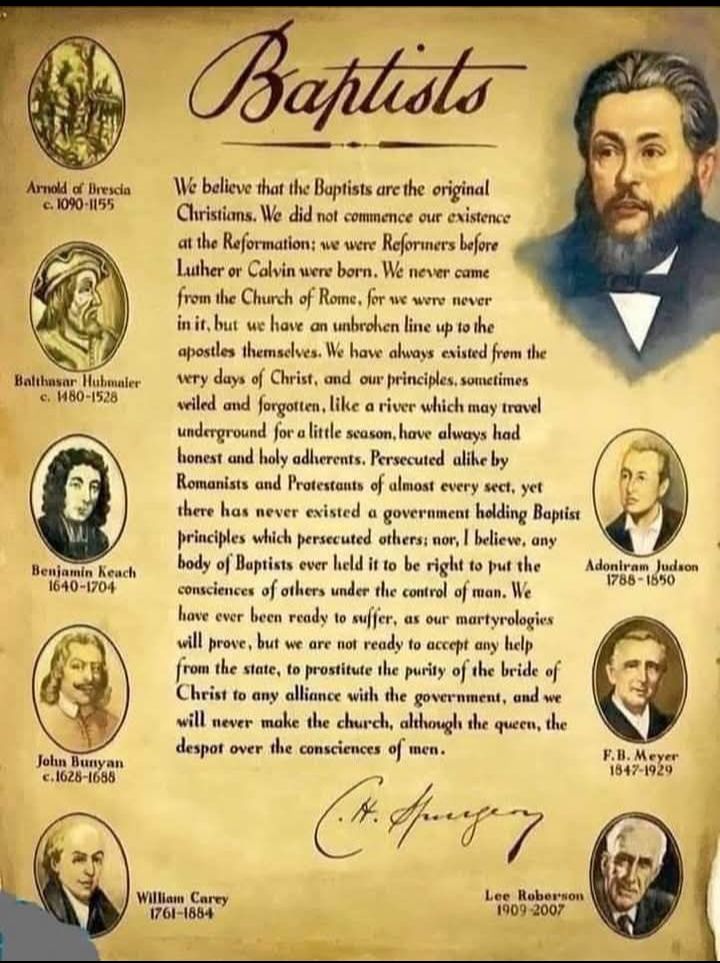
2- Baptists are dispensationalists in the sense of ministration to God, for we no longer offer animal sacrifices and no longer have an office of priests but believe in the priesthood of all believers (1 Pet. 2:9). But Baptists are not ultra-dispensationalists in the sense of dispensational salvation like the Campbellites and others alike, for down through the ages the only salvation that God gives to a sinner is only by His sovereign grace alone. Baptist are no Reformers for we existed prior to Martin Luther nor its doctrines of Salvation (Doctrines of Grace) called Reformed doctrines for these truths never DEFORMED down through centuries since Christ taught this to His church (Matt.28:20), and The Holy Spirit always bring to remembrance what Christ taught before to His church (John 14:26). Pillar and ground of the truth is always pointing to the institution where Christ founded and where all His teachings preserved down through centuries since He organized it and until these present days His Church always be the Pillar and ground of the truth where man-made churches and apostates churches cannot qualified. Doctrinal truths and True churches goes hand in hand, truth continous to spread despite adversaries because church perpetuates, that’s the same belief held by of the late Pastor Charles Haddon Spurgeon, as he said:
2 Tim. 2:19 “The Lord knoweth them that are his. And, “Let everyone that nameth the name of Christ depart from iniquity.”
This passage does not imply a universal, invisible church. Rather, it was written by the Apostle Paul to Timothy with direct application to the local church—just as in the case of Hymenaeus and Philetus, who strayed from the truth. This is no different from the first church at Jerusalem, which included Judas Iscariot, whom Christ Himself called a devil.
Being an organizational member of a local church does not in itself make one a child of God; likewise, not being a member of a local church does not automatically mean one is a reprobate. There are those who, though not members of a local congregation, are truly God’s children by virtue of being born again of the Spirit. Yet, being a child of God without baptism from the true church that Christ established means one is not a member of Christ’s church.
Acts 2:41, 47 “Then they that gladly received his word were baptised: and the same day there were added unto them about three thousand souls…” “Praising God, and having favour with all the people. And the Lord added to the church daily such as should be saved.”
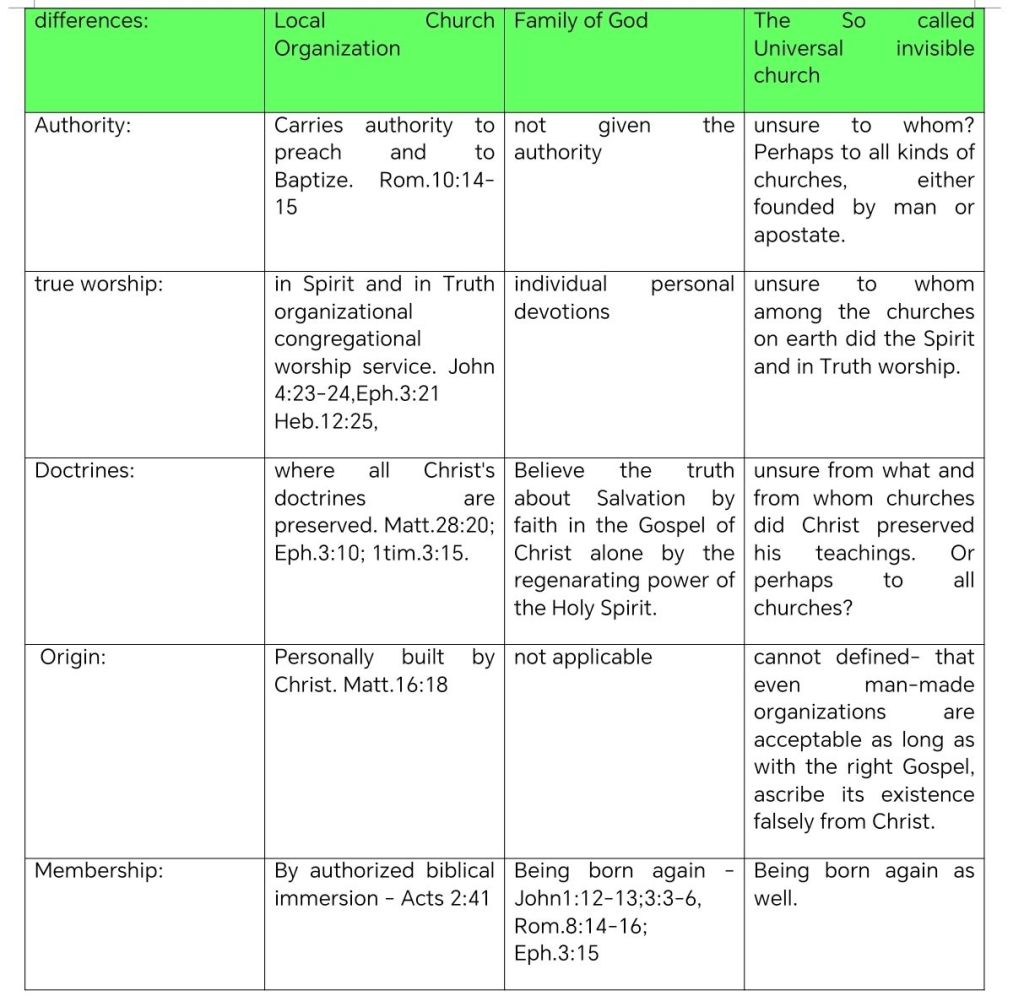
3-I believe the real problem lies in equating the church, as the organization built by Christ, with the family of God, which speaks of the spiritual relationship and union brought about by regeneration. This confusion gave rise to the theological innovation of the Reformers, namely, the concept of a so-called universal invisible church.
Below is a brief illustration highlighting the distinctions between the Church of Christ, the family of God, and the supposed universal invisible church.
4- One church , one baptism
Your argument :
The word church is used in these two different ways in the New Testament. It is used to describe all believers in all ages from all nations. This is the church, the elect of God, the body of Christ, which is called the invisible universal church. It is invisible, not because Christians lack visible bodies, but because membership of this true church is known only to God. It is universal because it includes those from all nations, and all ages who are truly converted. It includes some who may not be members of any particular local church due to unusual circumstances. It excludes some who are members of a local church, because God knows that they have never trusted in Christ, and they will be told on the last day, ‘I never knew you.’
The universal church is referred to in all passages where the singular word church is used, and where the context makes clear that more that a single local church is being referred to. This can be seen, because the statement requires us to understand more than just a single location or more than just a single point in time. It can also be seen where what is referred to is an entity known only to God, or which is in heaven – obviously, no false Christians can enter into heaven.
Such places include Matthew 16:18, where Christ looks forward in time to the end of the world and assures his disciples that he is building a church – a single church – which will at no point be overcome by Satan. Clearly this is not a local church, because no local church ever contained all those included in this statement. It includes that from all nations of the world, as well as those to be born in the distant future.
Throughout Ephesians the word church refers to the invisible universal church. Paul is speaking there of a single entity. His statements transcend any one time. Christ died for the church; he only died once; he died for the entire church at one time, including every individual who will ever be saved. The church is his bride. He only has one bride. It is used in the universal sense in Colossians 1:18 and 1:24 because these are universal statements, but it is used in the local sense in Colossians 4:15 and 4:16 because there is obviously a local application of the word.
As soon as the word is plural – churches – we know that the local church is being spoken of. As soon as a church in a particular locality is spoken of we know we are looking at a local church. A local church is a manifestation of the church universal in a particular location. Hence Paul refers to ‘the church of God which is at Corinth’ (1 Corinthians 1:2). It is a colony of heaven on earth in a particular location, comprised of identifiable individuals. The local church has all the blessings of Christ in a particular place. It has Christ as its head. It has his gifts in the form of pastor and evangelists, and it even has the gift of apostles and prophets (because they gave us New Testament revelation and every local church is founded on the word of God)
The church metaphors refer to the universal church. They are the bride of Christ, the flock of Christ, the true vine, the temple of the Lord, the body of Christ. These all refer to the universal church, because there is only one bride, flock, vine, temple or body. Nevertheless, they also refer to the local church, because the local church is the universal church manifested in a particular place and time. It should have all the characteristics of the universal church.
My response:
- 1Ephesian 4:4-5 “There is one body, and one Spirit, even as ye are called in one hope of your calling; One Lord, one faith, one baptism”.The Scriptures are very clear that there is only one Body (referring to the Church), not two, in its usage in the New Testament—for otherwise, it would contradict the text above. What you are referring to is not the church in the biblical sense. What you are describing is the whole number of God’s elect in all ages, which is known only to God, and this is called “the family of God” in its true biblical term, its not the universal invisible church (Ephesians 3:15).
- The Church is the earthly organized institution built by Christ, which ought to be composed of God’s children. However, not all who are part of that institution necessarily belong to God’s family, such as Judas Iscariot, whom our Lord chose to be one of the apostles of His earthly institution.If we grant your interpretation of the texts, then by the same reasoning, we would also end up with two Spirits of God, two hopes, two Lords, two baptisms, and two Heavenly Fathers. I am quite sure you would not agree with that.
- Matthew 16:18 does not refer to a “universal invisible church”; rather, it refers to a single, visible, organized entity. There would be no sense in speaking of persecution “unto death” or of the church prevailing against “the gates of Hades/hell” if the church were invisible.
- Throughout Ephesians, where the word church is used in reference to the body for which Christ died, it speaks of His single visible entity of organized institution, His church, in that locality. Paul wrote with knowledge of their profession of faith, as required before becoming members of the church through biblical baptism, though only God truly knows who are redeemed.
- Indeed, Christ has only one bride. Landmark Baptists have never taught that Christ has many wives.“I Jesus have sent mine angel to testify unto you these things in the churches. I am the root and the offspring of David, and the bright and morning star. And the Spirit and the bride say, Come. And let him that heareth say, Come. And let him that is athirst come. And whosoever will, let him take the water of life freely.” (Revelation 22:16–17).Notice in verse 16 the plural churches, while in verse 17 the reference is to a single bride. This implies that the Bride of Christ is His one organized body of entity, consisting of many assemblies but of one institution built by Christ.
- To claim that the Bride of Christ includes all the children of God in all ages would necessarily place John the Baptist who is explicitly called himself the friend of the Bridegroom (John 3:29) is likewise one the Bride? Bestman in every wedding ceremony cannot be the bride of course, and i think we can agree on that.
- John 3:29- “He that hath the bride is the bridegroom: but the friend of the bridegroom, which standeth and heareth him, rejoiceth greatly because of the bridegroom’s voice: this my joy therefore is fulfilled. Consider the context: John was with his disciples when they said in verse 26, “… Rabbi, he that was with thee beyond Jordan, to whom thou barest witness, behold, the same baptizeth, and all men come to him.” Both Christ and John the Baptist had their disciples, a visible company of people. In verses 27–28, John affirmed Christ’s authority from heaven and identified Him as the Christ. In verse 29, John declared that the Bridegroom is Jesus Christ, while he himself is the friend of the Bridegroom. In verse 30, John confessed, “He must increase, but I must decrease.” This is an explicit acknowledgment of the visible company of people who would follow Christ and grow in number, while John’s ministry must diminish. Thus, he places himself outside the Bride, as merely the friend of the Bridegroom.
- To say that a local church is merely a manifestation of a universal invisible church in a particular location is unscriptural. First, such an idea is neither found nor implied in Scripture. Second, this would destroy the true identity of the church Christ personally started and founded as a visible company of saints. Third, it would imply that all local congregations—despite false teachings—are true churches of Christ, so long as they contain visible saints. Fourth, it would mean that all forms of man-made churches, even cults, would be accepted as having valid authority to preach and baptize.
- God set His Church first through the visible apostles (1 Corinthians 12:28). He did not begin building it with Adam, the Patriarchs, or the Old Testament nation of Israel. The authority of the Great Commission was not entrusted to the Jewish nation, nor to Constantine’s church, nor to Martin Luther’s church, nor to John Calvin’s church, nor to any other man-made church. Rather, God entrusted it to the second Person of the Trinity, Jesus Christ, who gave the promise of perpetuity to His visible company of saints—those prepared for Him by John the Baptist (Luke 1:17).
- The metaphors of flock, temple, and body always refer, in their contexts, to a local visible church assembly. The metaphor of the vine (John 15) refers to Christ as the true Vine and speaks of our spiritual relationship to Him, not of a church. If it did refer to the church, then as verse 6 states, “If a man abide not in me, he is cast forth as a branch, and is withered; and men gather them, and cast them into the fire, and they are burned”, salvation would be tied to church membership. But since you hold that the local church is the manifestation of a universal invisible church, that conclusion would follow—yet it is unbiblical and unacceptable to us as Baptists.
5- The church Institution
Your Argument:
The word church is never used in the Bible to refer to a denomination or to a national church. These are not institutions established by Christ. The only institutions he has established is the universal church, and the only form in which is can be manifested on earth is the local church.
Christ only has one body, not many. There are no mistakes in making someone a member of this body, for we become members of his body, not by water baptism, but by baptism of the Spirit (1 Corinthians 12:13). This happens at conversion, when we repent and believe. At that time we who are many are made members of Christ’s body. The local church has no power to make anyone a member of Christ’s body. It can only recognise what the Spirit has already done, and apply water baptism and welcome those who Christ has already converted into the local church. It should not refuse those who he has saved, and it should not receive any he has not saved. Water baptism – which is the only baptism the local church has power to carry out – does not save anyone. It is a picture of what Christ by his Spirit has already done in that life when he made that one a member of his true church, his true body.
My reply:
Actually, Christ did established His single, local, visible organized body of institution to carry out the Great Commission and His teachings (Matt. 28:18–20; John 20:21). Over time, its branches spread throughout the world, but all remained of one kind of institution.
To illustrate: the late Charlie Kirk founded his organization Turning Point: America, with its advocacy of protecting the sanctity of marriage, promoting family values, and seeking the glory of God. Mr. Kirk’s organization now reaches across the globe—in Europe, Asia, and even Australia—yet each local branch follows the same goals he established, acknowledging him as its head and founder, though it began only in America. Thus, there arose “TP: Europe,” “TP: Korea,” and “TP: Australia.” There may be other organizations with similar advocacy, but they were founded by other men. Perhaps in the future, some may abandon Mr. Kirk’s advocacy, twist its goals, and become apostate to the principles laid down by the late Charlie Kirk.
In like manner, Christ established His church, which first began in Jerusalem. Through persecution it was scattered, reaching Samaria (Acts 8:3–14) and then Antioch (Acts 11:19–27). From the church at Antioch, the Apostle Paul was commissioned and sent out with Barnabas as a missionary (Acts 13:1–3). During Paul’s missionary journeys, churches were organized: first with Barnabas (Acts 13:2–14:28), then with Silas (Acts 15:36–18:22), and finally in his third journey (Acts 18:23–21:17). The same body of organization that began in Jerusalem under the headship of Jesus Christ spread throughout the world and has continued to exist through the centuries, even amidst persecution. This is the biblical principle known as the “link-chain succession of churches.”
This doctrine stands in direct opposition to the Roman Catholic claim of apostolic succession, which asserts that the Apostle Peter was the first pope in Rome and that the church at Rome holds supremacy over all of Christ’s churches—a notion completely absent from Scripture. While some churches were founded by men with man-made doctrines, or borrowed from Christ’s true churches yet remained of human origin, such churches are not owned by Christ. Furthermore, some churches that were once true have fallen into apostasy. Though they began as part of Christ’s organization, they departed from His faith and doctrine and therefore ceased to be light-bearers of Christ in this world.
The idea of a universal, invisible church cannot fulfill the institutional commission of the Kingdom of God. It cannot establish the true organized church founded by Christ, nor can it distinguish between schisms, valid authority to preach and baptize, the true authorized representatives of Christ’s visible church, or the true worship that God seeks (Mark 7:7; John 4:23–24).
1 Corinthians 12:13 does not refer to the baptism of the Spirit. It means that by one Spirit, or by the leading of the Holy Spirit (v. 11), we are all baptized into one body—the one body of organization founded by Christ. From verse 7 to verse 11, the profitable manifestations of spiritual gifts can only be exercised in a visible assembly of saints. Verse 27 clearly shows visible membership in particular, which God sets in the church (v. 28): first apostles, then prophets (not Old Testament prophets, but New Testament ones, cf. 1 Cor. 14:29, 31, 37).
If we allow another interpretation, it would imply two kinds of baptism. Yet Ephesians 4:5 teaches there is only one baptism. Matthew 28:19–20 reveals this baptism to be water baptism, commanded in the Great Commission and given to the organized institution founded by Christ.
Brother, please don’t misunderstand—we do believe in spiritual baptism, but it is no longer applies to us since the completion of the Holy Scriptures. Regeneration is not spiritual baptism but the new birth in Christ. Spiritual baptism occurred only in the early days of the church organization founded by Christ.
Spiritual baptism was the outpouring of spiritual gifts to empower the infant church of Christ. Acts 1:8 (KJV) uses the word “power” (dunamis—meaning energy, strength, might, power).
Acts 1:4–5, 8 says: “And, being assembled together with them, commanded them that they should not depart from Jerusalem, but wait for the promise of the Father, which, saith he, ye have heard of me. For John truly baptized with water; but ye shall be baptized with the Holy Ghost not many days hence…. But ye shall receive power, after that the Holy Ghost is come upon you: and ye shall be witnesses unto me both in Jerusalem, and in all Judaea, and in Samaria, and unto the uttermost part of the earth.”
->Notice that the angels told the disciples to remain in Jerusalem until they were baptized by the Holy Spirit. We cannot say that the eleven apostles and the one hundred twenty disciples gathered there (Acts 1:15) were not yet born-again believers until they received spiritual baptism along with its accompanying gifts.
Spiritual baptism is always accompanied by spiritual gifts in Scriptures (Acts 2:1–18; 10:44–46; 19:4–6). However, these gifts ceased when that which is perfect came (1 Cor. 13:8–10). This “perfect” does not refer to a person, but to the perfect Word of God—the completed Scriptures (Psa. 18:30; 19:7; John 17:17; 2 Tim. 3:16–17). In our time, the offices of apostle and prophet, along with their spiritual gifts and miracles, no longer exist. What we have now are evangelists, pastors, and teachers for the perfecting of the body of Christ (Eph. 4:11–13).
6- The Bride and Marriage of the Lamb
Your Arguments:
In Revelation 18:20 a great angel commands heaven and the holy apostles and prophets to rejoice at the destruction of Babylon. In Revelation 19 we see the result of this command to rejoice. John hears a great voice of much people in heaven ‘saying, Alleluia; Salvation, and glory, and honour, and power, unto the Lord our God.’ This is the sound of the rejoicing of all who are saved including the apostles and prophets. They celebrate the righteous judgment of God, and the smoke of Babylon going up for ever and ever. In Revelation 19:4 the twenty-four elders representing all believers in heaven (twelve plus twelve), and the four beasts (or living creatures) representing the angels, both worship together. Saved men and elect angels praise God together. In verse 5 a voice comes from the throne of God instructing all in heaven to worship God. They are identified as his servants, those who fear God both small and great. This is the totality of those who are saved. It includes all the saints both Old Testament and New Testament. The result is that John hears the voice of a great multitude. They begin to praise God in verse 6, ‘Alleluia: for the Lord God omnipotent reigneth’, and they continue to speak in verse 7. Those who are speaking are all God’s servants, all the elect. They include the apostles and prophets referred to in chapter 18:20. This great multitude speaks about the bride who has made herself ready, but the apostles too are part of the bride, for the bride is the church, and the church is built on the foundation of the apostles and prophets. The names of the twelve apostles are written on the gates of the new Jerusalem, which represents the church as a city in yet another figure (Revelation 21:2, 14). The new Jerusalem is another name for the church. This refers to Jerusalem which is above, which Paul says is the mother of us all (Galatians 4:26), that is, the mother of all believers.
‘And to her was granted that she should be arrayed in fine linen, clean and white: for the fine linen is the righteousness of saints’ (Revelation 19:8). The wife of the Lamb is granted to be clothed in white linen, representing the righteousness of saints. The same white linen is granted to every believer for it represents the righteousness which is imputed to all who believe. Doesn’t Paul prove the doctrine of justification by faith and the imputation of righteousness from the case of Abraham? (Romans 4:1-3). Isn’t the same righteousness given to Old Testament saints as to New Testament saints? Certainly it is. Yet the church is distinguished here as her who is clothed in fine linen which is the righteousness of saints. The saints are all those who are saved in all ages and all lands and from all ethnic backgrounds. Later in Revelation 19:14 the same white linen clothes the armies of heaven which follow after Christ.
Those who are invited to the marriage supper of the lamb are not different to the bride herself. The bride is made up of many people. These are represented as those who are present at the marriage supper. The same imagery is used in Matthew 22:2-14 where Christ is speaking of those gathered into the church through the preaching of the gospel, and where they are described as guests invited to the marriage supper of the king’s son. We should not be pedantic about this, as if we need to distinguish between the bride and the guests. These are two different ways of looking at the same blessed occasion, and the same blessed individuals. The parable of the marriage supper is a gospel parable, and it about those who are saved under the preaching of Christ, yet they are called wedding guests. The same illustration of a wedding garment is used in this parable, without which none are entitled to be at the wedding (Matthew 22:11). It is the same garment given to the bride that makes her fit to be there.
When Christ says to his disciples, ‘And I say unto you, That many shall come from the east and west, and shall sit down with Abraham, and Isaac, and Jacob, in the kingdom of heaven’ (Matthew 8:11), he is telling them that the Old Testament saints will also be guests at the wedding feasts. They too are included. They will sit down with the apostles as fellow guests. The same way of salvation operates in the Old Testament as in the New Testament. There is only, and there can only be, one way of salvation for all. Abraham, Isaac, and Jacob will be joined by many others wedding guests at the same feast. There will be no distinction in status between them.
John the Baptist says, ‘He that hath the bride is the bridegroom: but the friend of the bridegroom, which standeth and heareth him, rejoiceth greatly because of the bridegroom’s voice: this my joy therefore is fulfilled’ (John 3:29). To interpret this correctly we must pay attention to the scope of John’s illustration. As usual in interpretation the context is very important. The context here is a question being disputed between some of John’s disciples and the Jews about purifying. John’s disciples come to him and ask him about Jesus Christ, and whether it is right that people should be going to him to be baptized, rather than coming to John. John’s answer is designed to show the relative unimportance of his earthly ministry compared to Christ’s. That is the scope of the illustration, and nothing more. John is like a friend at a wedding who rejoices to see the happiness of the bridegroom and bride coming together. The friend looks on with great joy. He would not for a moment require the bride to give more attention to him: he is only a friend at someone else’s wedding; he is not the bridegroom. He is explaining why he is perfectly content to see his disciples leaving him and going and following Jesus, as Andrew and John did (John 1:40). He must decrease while Christ increases. To say that by these words John is defining his eternal status – that in all eternity he will never have that close relationship with the Lord which the church has – is to completely mishandle this passage.
My response:
In Matthew 9:15 -“And Jesus said unto them, Can the children of the bridechamber mourn, as long as the bridegroom is with them? but the days will come, when the bridegroom shall be taken from them, and then shall they fast.”
Christ calls Himself the Bridegroom, and if there is a Bridegroom, there must be a bride. Scripture never teaches that the bride is some vague, invisible, universal mass of all the saved; rather, the bride is the church which Christ Himself established during His earthly ministry. The “children of the bridechamber” are His disciples, the very ones He had already called out, organized, and covenanted together as His first assembly, His church. To make them into “all the redeemed” is to twist the text beyond recognition. The presence of the Bridegroom with His church was a time of joy, not fasting, for a wedding is no place for mourning. Notice carefully—Christ says the Bridegroom would be taken from them. Not from all believers of all ages, but from that visible, functioning body that felt His bodily absence after His ascension. If the church were some invisible universal thing, Christ’s words lose all meaning. This text proves beyond question that the church was already in existence before Pentecost, for one cannot have a Bridegroom with His bride if the bride does not yet exist. Nor can one speak of fasting when an “invisible, universal church” has never once assembled to rejoice in His presence. The universal church theory collapses under the weight of this passage, but our Landmark Baptist position stands clear: Christ, the Bridegroom, established His local, visible assembly as His bride, and it is that body alone that He promised to love, preserve, and present to Himself in glory.
Revelation 18–19: Distinguishing the Multitude from the Bride.
In Revelation 18:20 heaven, the apostles, and prophets are called to rejoice at Babylon’s fall. Revelation 19 shows a great multitude in heaven doing so (vv. 1–6). This multitude indeed represents all the redeemed, together with angels, glorifying God. But notice the crucial transition:
In verse 7, the subject narrows: “Let us be glad and rejoice, and give honour to him: for the marriage of the Lamb is come, and his wife hath made herself ready.”
This is a shift in imagery. The rejoicing of all the saved gives way to the announcement of the bride, which is distinguished from the multitude. The text does not say “the multitude is the bride,” but rather that the multitude praises God because the bride is ready.
Thus, the multitude and the bride are related but not identical. The guests rejoice at the bride’s readiness. This is consistent with Christ’s parables (Matthew 22, Matthew 25) where wedding imagery distinguishes between the bride/bridegroom and the guests. The king did not invite the guests to be his son’s bride. The ten virgins who are the lamp bearers are not the components of the Bridegroom’s Bride.
Revelation 19:8 – The Righteousness of Saints
It is true that the “fine linen” represents the righteousness of the saints (v. 8). But this does not erase the distinction between saints generally and the institutional bride. All saints are righteous by imputation, but not all saints are described as the bride. The text specifies: “to her was granted that she should be arrayed.” The “her” is not the entire multitude, but the wife/bride identified as a distinct entity.
To read “all saints in all ages” into the “her” is eisegesis, not exegesis. The passage itself draws a boundary between the rejoicing multitude and the prepared wife.
–>>*I have further explanation below on this texts.<—
The Bride Defined in Relation to Christ’s Institution
In Scripture, the bride imagery consistently ties to the visible, covenantal people of God gathered as an institution:
In the Old Testament, Israel (a visible nation under covenant) is called God’s wife (Jeremiah 3:14; Hosea 2:19–20). Not all Jews were truly regenerate, yet the nation as an organized, covenant-bound body bore that corporate identity.
In the New Testament, Christ’s church—His visible, organized assembly—is His bride (Ephesians 5:23–32). The analogy continues: it is not every individual believer in every age, but the organized, covenanted body that bears the title.
If the bride equals all saints, then the Old Testament nation of Israel and the New Testament church would both be brides of God, and Christ would effectively have “two wives.” But Paul explicitly says, “I have espoused you [the church at Corinth—a local body] to one husband, that I may present you as a chaste virgin to Christ” (2 Corinthians 11:2).
Thus, the bride is always organized, covenantal and institutional, not merely a collection of individuals who happen to be saved.
Matthew 8:11-“And I say unto you, That many shall come from the east and west, and shall sit down with Abraham, and Isaac, and Jacob, in the kingdom of heaven.”
-Sitting in the kingdom of heaven with Abraham and the other patriarchs of faith signifies being among the most honored guests—the “VIPs”—at the marriage table of the Kingdom of God. They belong to the family of God, and one of them, John the Baptist, holds the very special role of being the friend of the Bridegroom. In any marriage ceremony, there are significant figures whose presence is essential on both sides of the union. As illustrated in Matthew 22:1–14, the King (the Father) is present with His servants, and the friend of the Bridegroom—the best man—plays an important role as well.
On the side of the Bride stand her family in the faith. Here we see Abraham, the father of faith, together with the Old Testament saints and New Testament saints who, though not members of the Lord’s bridal church, are nevertheless described as virgins (churches) who bear the light of the gospel of salvation. They possess the “oil,” which is the Holy Spirit, as born-again believers—just as reflected in the parable of the wise virgins in Matthew 25:1–13.
Other texts are address above while others below-
7- People in heaven:
Your Argument:
There is only one category of people in heaven, not two. There is not one class which is more intimate with Christ than another. All have the same access to him, the same familiarity with him. If there were really different classes of people in heaven, the one represented by the bride and the other by guests at the wedding, then we would have to say that some will have a more intimate relationship with Christ than others. But there is no two-tier system in heaven. Who can be closer to the bridegroom than the bride? The guests are not allowed into the bridal chamber on the wedding night. The bride alone is there, and she is intimate with the bridegroom in a way that the guests are not. To say that Old Testament saints are not part of the bride is to say that they do not have same intimacy with Christ, but Christ says otherwise. He says that the saved Gentiles will join together with Abraham, Isaac, and Jacob.
In Ephesians 2 Paul says, ‘But now in Christ Jesus ye who sometimes were far off are made nigh by the blood of Christ. 14For he is our peace, who hath made both one, and hath broken down the middle wall of partition between us; 15Having abolished in his flesh the enmity, even the law of commandments contained in ordinances; for to make in himself of twain one new man, so making peace; 16And that he might reconcile both unto God in one body by the cross, having slain the enmity thereby: 17And came and preached peace to you which were afar off, and to them that were nigh. 18For through him we both have access by one Spirit unto the Father. 19Now therefore ye are no more strangers and foreigners, but fellowcitizens with the saints, and of the household of God; 20And are built upon the foundation of the apostles and prophets, Jesus Christ himself being the chief corner stone; 21In whom all the building fitly framed together groweth unto an holy temple in the Lord: 22In whom ye also are builded together for an habitation of God through the Spirit’ (Ephesians 2:13-22). This is about the reconciliation of Jew and Gentile. From this passage we learn that New Testament saints have been brought into the blessings that already belonged to Old Testament saints, to Abraham, Isaac, and Jacob all other believing Jews. The situation was that the Gentiles were largely excluded from blessing under the old dispensation. The promises were to the seed of Abraham, which was understood to be the physical seed. It was a mystery Paul says, ‘Which in other ages was not made known unto the sons of men, as it is now revealed unto his holy apostles and prophets by the Spirit; 6That the Gentiles should be fellowheirs, and of the same body, and partakers of his promise in Christ by the gospel’ (Ephesians 3:5-6). The believing Jews already had the blessings of the gospel. What was so surprising and so marvellous was that God had brought Gentiles into the same blessing. That is the way round that Paul looks at it. This is not just making the point that the church is composed of Jew and Gentiles, and that ethnic background counts for nothing in the kingdom of heaven. It is teaching that what seemed like an immoveable obstacle – the hatred which existed between Jew and Gentile on the basis – has been removed by Christ who has allowed all to enter his kingdom on the same basis – ‘which were born, not of blood, nor of the will of the flesh, nor of the will of man, but of God’ (John 1:13). Paul says here that Christ has reconciled Old Testament Jewish saints and New Testament Gentile saints. There was an enmity between them – the Jews thought they were different and no Gentile could have the same blessings as them without virtually becoming a Jew – but the enmity has been removed by Christ. He has put all in one body by abolishing in his flesh the law of commandments contained in ordinances. The ceremonial law appeared to make distinction between Jew and Gentile which could never be removed, but Christ has abolished it by fulfilling in his person. Abraham, Isaac, Jacob, and Moses are all made one, of the same body as every believing Gentile. The moral law also was destroyed by Christ in the sense that he took the punishment of the law which was assigned to both Jew and Gentile, and set both free from condemnation. All are part of one body which is the church of Christ.
My response:
Hebrews 12:22–23 says:
“But ye are come unto mount Sion, and unto the city of the living God, the heavenly Jerusalem, and to an innumerable company of angels, To the general assembly and church of the firstborn, which are written in heaven, and to God the Judge of all, and to the spirits of just men made perfect.”
-This passage is often used by universal invisible church advocates to describe what they believe is the “future glory” of a universal church in heaven. Yet, a careful hermeneutical study shows this is not what the text teaches. Instead, it reveals a categorical distinction of persons in heaven.
- “Ye are come” — The phrase is in the present tense. It does not refer to a past event or a future hope, but to a present reality for the Christian Hebrews. The “ye” addresses believers who were assembling together (Heb. 10:25). Their “coming unto Mount Sion” is not a literal ascent to heaven, but a spiritual approach into the very presence of the omnipresent God, whose dwelling is described as the heavenly Jerusalem — the dwelling place of the Bride (Rev.21:2,9).
- The Greek word kai (“and”) — This conjunction separates the categories listed in the text: “the general assembly,” “the church of the firstborn,” and “the spirits of just men made perfect.” These are not one blended group, but distinct groups mentioned side by side.
-The general assembly (panēguris): This is a festal gathering, consisting of the heavenly host/angels who are present in worship whenever God’s people assemble on earth (cf. 1 Cor. 11:10; Eph. 3:10).
-The church of the firstborn: This refers to the congregation of Christ, the present New Testament assembly on earth, the only society/organization “written in heaven” (or “enrolled in heaven,”( LSB). This is the local body of Christ established, whose authority and discipline on earth are recognized in heaven (Matt. 18:17–20).
-The spirits of just men made perfect: This describes the Old Testament saints who have been perfected through Christ and now stand as a “cloud of witnesses” (Heb. 11:40; 12:1).
Revelation 19:6-9
Verse 6- “And I heard as it were the voice of a great multitude, and as the voice of many waters, and as the voice of mighty thunderings, saying, Alleluia: for the Lord God omnipotent reigneth.
Verse 7-Let “us” (the great multitude) be glad and rejoice, and give honour to him: for the marriage of the Lamb is come, and his wife hath made herself ready.
->this great multitude are the much “people” “crowd” in verse1, the servants of God great and small in verse5. This great multitude of redeemed saints identify separately themselves from the Bride, as they said “His wife hath made herself ready”. They didn’t said we made ourselves ready.
Verse 8-And to her was granted that she should be arrayed in fine linen, clean and white: for the fine linen is the righteousness of saints.
-> this fine linen represents the righteousness of the saints, the Greek word “dikaiōmata” that is plural that translated righteous acts of saints(LSB) is not the same emputed righteousness of Christ, the Greek word “dikaiosünēn” which is singular rooted from the lone perfect righteousness of Christ towards us who are redeemed ( Rom.4:6;2Cor5:21;Phil.3:9).
->This plural “righteousness,” referring to the Bride, speaks of a collective yet individual righteousness of the saints. It points to the righteous deeds that follow believers beyond death (Rev. 14:13), the works that will be tested by fire in order to receive reward from God (1 Cor. 3:13–15). Such rewards can only be obtained within the church institution built by Christ (Rev. 3:11)—the church that prepares herself by being cleansed through God’s word (Eph. 3:10; 5:26–27) and is presented as a chaste virgin (2 Cor. 11:2). But if churches holding heretical doctrines—such as libertarian free-will salvation, or infant baptism, or sacramental maintaining salvation—are to receive equal rewards, then our contending for the faith and the truth would be rendered meaningless.
Verse 9- And he saith unto me, Write, Blessed are they which are called unto the marriage supper of the Lamb. And he saith unto me, These are the true sayings of God.”
-> There’s no marriage occasion where the bride is the guest but instead the bride also who invites her guests “The Spirit and the Bride say Come”(Rev.22:17).
Revelation 21:1-5-“And I saw a new heaven and a new earth: for the first heaven and the first earth were passed away; and there was no more sea. And I John saw the holy city, new Jerusalem, coming down from God out of heaven, prepared as a bride adorned for her husband. And I heard a great voice out of heaven saying, Behold, the tabernacle of God is with men, and he will dwell with them, and they shall be his people, and God himself shall be with them, and be their God. And God shall wipe away all tears from their eyes; and there shall be no more death, neither sorrow, nor crying, neither shall there be any more pain: for the former things are passed away. And he that sat upon the throne said, Behold, I make all things new. And he said unto me, Write: for these words are true and faithful.
The Holy Spirit gives us one of the clearest pictures in all of Scripture regarding the Bride of Christ and her eternal distinction from others who are redeemed. The angel does not leave room for speculation or broad ecumenical theories, but declares plainly: “Come hither, I will shew thee the Bride, the Lamb’s wife” (21:9). What John sees is not an abstract invisible body of all the saved, but the holy city, New Jerusalem, descending out of heaven into the new heaven and new earth. This city is described in bridal terms, “prepared as a bride adorned for her husband” (21:2), the same being prepared by Christ to His church(John 14:1-3). She is His one Bride, His one institution/organization, local and visible in time, now exalted and perfected in eternity.
But John also makes a striking distinction: “The nations of them which are saved shall walk in the light of it” (21:24). Here we see that not all the saved are the Bride, for the nations are expressly differentiated from her. They are redeemed, yes, but they are not the city; they do not constitute the wife of the Lamb. Instead, they walk in her light and bring their glory and honor into it. The city shines with the Lamb’s glory, and the nations benefit from that glory, but they are not the Bride herself. If all the redeemed of all ages were the Bride, such language would be meaningless, yet Scripture speaks with precision to show us otherwise. Just as at a wedding there is one wife and many guests, so in eternity there is one Bride the church and many saved nations who are called guests enjoy her blessed light.
Further still, John draws a boundary that no man can cross: “For without are dogs, and sorcerers, and whoremongers, and murderers, and idolaters, and whosoever loveth and maketh a lie” (22:15). Here we see the third and final division. The Bride dwells in the city. The nations of the saved walk in her light. But the wicked are forever without. This “without” does not mean they merely linger outside the walls of the New Jerusalem, for Revelation 20 has already cast them into the lake of fire. Rather, this “without” is the same “outer darkness” of which our Lord spoke (Matt. 8:12; 22:13; 25:30)—a realm of weeping and gnashing of teeth, utterly cut off from the light and glory of the new creation. The open gates of the New Jerusalem signify not danger of intrusion, but absolute security; they are open because no evil exists within the new heaven and new earth. The lost are outside altogether, banished to everlasting destruction.
Thus Revelation gives us an eternal threefold division: the Bride, which is Christ’s church in glory; the nations of the saved, who rejoice in her light; and the lost, who are forever without in the outer darkness. This testimony completely destroys the popular but unscriptural theory that all the redeemed of all ages make up the Bride. The Word of God itself refutes that confusion. Christ has one Bride, His church—the very body He built in His earthly ministry, preserved through the ages, and glorified at last as the New Jerusalem. To blur the nations of the saved into the Bride is to contradict the plain distinctions of Revelation. To ignore the lost without is to deny the reality of outer darkness. But to hold fast to these distinctions is to uphold the ancient Landmark truth: that the church of the Lord Jesus Christ, and she alone, is the Bride, the Lamb’s wife, while the nations of the redeemed enjoy her light, and the ungodly remain forever outside, in darkness, where there is no light at all.
Ephesians chapter 2 verse 14 to 22,
The wall of partition explained by the Pastor of Metropolitan Tabernacle Dr. John Gill said: “and hath broken down the middle wall of partition between us”; the ceremonial law, which was made up of many hard and intolerable commands, and distinguished, and divided, and kept up a division between Jews and Gentiles: so the Jews call the law a wall, “if she be a wall”, Song of Solomon 8:9 זו תורה, “this is the law”, say theyF4T. Bab. Pesachim, fol 87 1 : and hence we read of חומת התורה, “the wall of the law”F5Caphtor, fol 95 1 & 101 1 ; and sometimes the phrase, a “partition wall”, is used for a division or disagreement; so R. Benjamin saysF6Itinerar p 28 , that between the Karaites and Rabbanites, who were the disciples of the wise men, there was מחיצה, “a middle wall of partition”; a great difference and distance; and such there was between the Jew and Gentile, by reason of the ceremonial law; but Christ removed it, and made up the difference: the allusion seems to be to the wall which divided the court of Israel from the court of the Gentiles, in the temple, and which kept them at a distance in worship.
There are lots of Bible scholars commented that this wall of partition is related to the Jewish ceremonial laws that Gentiles are not permitted to have access into it.
->Ephesians 2:15-16, – “Having abolished in his flesh the enmity, even the law of commandments contained in ordinances; for to make in himself of twain one new man, so making peace; And that he might reconcile both unto God in one body by the cross, having slain the enmity thereby.”
— Christ has ended through the offering of His own body at the cross the O.T ceremonial laws and ordinances which separated the Jews and Gentiles, refer to:
Col.2:14-17 -“Blotting out the handwriting of ordinances that was against us, which was contrary to us, and took it out of the way, nailing it to his cross; And having spoiled principalities and powers, he made a shew of them openly, triumphing over them in it. Let no man therefore judge you in meat, or in drink, or in respect of an holyday, or of the new moon, or of the sabbath days: Which are a shadow of things to come; but the body is of Christ.”
Hebrews 8:13- “In that he saith, A new covenant, he hath made the first old. Now that which decayeth and waxeth old is ready to vanish away.”
Hebrews 9:10-“Which stood only in meats and drinks, and divers washings, and carnal ordinances, imposed on them until the time of reformation.”
-> Ephesians 2:17 “And came and preached peace to you which were afar off, and to them that were nigh. – ” “Afar off” are Gentiles; “nigh” are the Jews. Both now hear the same gospel of pepeace Acts 10:36 – “Preaching peace by Jesus Christ: (he is Lord of all).” Isa. 57:19 – A prophecy of peace to those afar and near.
->Ephesians 2:18 “For through him we both have access by one Spirit unto the Father.”
-Jews and Gentiles are united through Christ and the Spirit giving equal access to God.
Romans 8:14-16 “For as many as are led by the Spirit of God, they are the sons of God. For ye have not received the spirit of bondage again to fear; but ye have received the Spirit of adoption, whereby we cry, Abba, Father. The Spirit itself beareth witness with our spirit, that we are the children of God:
->Ephesians 2:19
“Now therefore ye are no more strangers and foreigners, but fellowcitizens with the saints, and of the household of God.”
-Believing Gentiles and Jews at Ephesus as Apostle Paul subjected to “YE” – are no longer aliens but members of God’s household (oikos = house/family). The “household of God” is the church.
1 Tim. 3:15 – “House of God, which is the church of the living God…”
Heb. 3:6 – Christ over His house, whose house we arare.
-> Ephesians 2:20- “And are built upon the foundation of the apostles and prophets, Jesus Christ himself being the chief corner stone.”
- This is earthly visible foundation of the single institution of Christ here on earth built upon the foundation of the Visible twelve Apostles that includes Judas Escariote(Luke 6:13; John6:70), and the prophets.
These prophets are not the same prophets of the O.T. times but these are prophets of the young church where like the Apostle’s office ceased after the completion of the “perfect”, the Bible (Psa.19:7).
Acts 11:27-“And in these days came prophets from Jerusalem unto Antioch.”
Acts 13:1-“Now there were in the church that was at Antioch certain prophets and teachers; as Barnabas, and Simeon that was called Niger, and Lucius of Cyrene, and Manaen, which had been brought up with Herod the tetrarch, and Saul.”
Acts 15:32-“And Judas and Silas, being prophets also themselves, exhorted the brethren with many words, and confirmed them.”
1 Corinthians 14:29-32,37 – “Let the prophets speak two or three, and let the other judge. If any thing be revealed to another that sitteth by, let the first hold his peace. For ye may all prophesy one by one, that all may learn, and all may be comforted. And the spirits of the prophets are subject to the prprophet….If any man think himself to be a prophet, or spiritual, let him acknowledge that the things that I write unto you are the commandments of the Lord.
-The Office of a prophet ceases nowadays – 1 Corinthians 13:8-10 “Charity never faileth: but whether there be prophecies, they shall fail; whether there be tongues, they shall cease; whether there be knowledge, it shall vanish away. For we know in part, and we prophesy in part. But when that which is perfect is come, then that which is in part shall be done away.”
->Ephesians 2:21-“In whom all the building fitly framed together groweth unto an holy temple in the Lord.”
— Each Local congregation is a temple of God. The church grows as living stones are added (1 Pet. 2:5).
1 Corinthians 3:9,16-17-“For we are labourers together with God: ye are God’s husbandry, ye are God’s building….Know ye not that ye are the temple of God, and that the Spirit of God dwelleth in you? If any man defile the temple of God, him shall God destroy; for the temple of God is holy, which temple ye are.
1 Peter 2:5-“Ye also, as lively stones, are built up a spiritual house, an holy priesthood, to offer up spiritual sacrifices, acceptable to God by Jesus Christ.
Acts 2:47 – The Lord added to the church daily.
->Ephesians 2:22-“In whom ye also are builded together for an habitation of God through the Spirit.”
- During Apostle Paul’s time upon writing his letter, the present Ephesian congregation, “YE”, itself is the “habitation of God.” The Spirit dwells among the gathered local assembly.
Matthew 18:20-“For where two or three are gathered together in my name, there am I in the midst of them.”
And what is more marvelous is that in every centuries Christ never leave His Church in spite of terrible persecutions, His very presence in the Spirit always abides His church even until now. That’s the reason why we, landmarkers never believed that the church built by our Lord Jesus Christ was completely gone or apostatize that it needed to be Reformed by Luther or Calvin, because at first point it never come completely gone its existence, authority and deformed its teachings. C.H.Spurgeon was in some point a landmarker.
Matthew 28:20
Teaching them to observe all things whatsoever I have commanded you: and, lo, I am with you alway, even unto the end of the world. Amen.
8 The Serious Error
Your argument:
I would have less problem with Landmarkism if it simply tried to establish an unbroken connection between Baptist churches today and churches in New Testament times, although I believe that this cannot be done. But when it goes on to teach that there is no universal church and that there are different categories of believer in heaven, this is as serious error which cannot be ignored. The genuineness of a church today is not based on some Baptist version of apostolic succession, but on the adherence of a church to Biblical doctrine.
My Response:
I really studied both sides of the view but i find lacking the scriptures proof on the teaching of universal invisible church. What i found out are serious errors and the ignored vitals truths from the scriptures. Let me sum it up the errors that i have drawn into conclusion base on this study.
1- The error of misidentifying the church set by God—which is Christ’s church beginning first the apostles (Luke 6:13; 1 Cor. 12:28).
2-The error of invalidating the role of John the Baptist in the preparation and to establish the institution of the Son of God (Luke 1:17; John 3:29).
3-The error of denying Christ’s promise of perpetuity to His church, which exists visibly until this day (Matt. 28:20). This view ignores the preserving presence of Christ with His beloved local, visible, organized institution—His Bride—which has endured persecution for centuries (Matt. 16:18).
4-The error of misidentifying the true representatives of the Great Commission, as if all types of churches—man-made, apostate, or even cultic—are equally valid representatives (Matt. 28:19; John 20:21; Rom. 10:14–15).
5-The error of failing to distinguish between true churches and false churches (1 Tim. 3:15).
6-The error of legitimizing the creation of rival competing churches, built by men to compete with the one Christ Himself established (1 Pet. 2:7–8).
7-The error of equating false churches as part of the Bride of Christ, which Scripture declares to be washed by His Word and presented without spot or blemish (Eph. 5:26–27).
8-The error of claiming that all types of churches—including those founded by men and built upon false doctrines—are nevertheless the depository of all God’s wisdom (Eph. 3:10).
9-The error of recognizing all types of worship from all types of churches as acceptable to God, when He Himself seeks and receives glory in true worship from His own true churches (Mark 7:7; Eph. 3:21).
10-The error of granting all types of churches equal authority to preach and baptize (Acts 19:3–5; Rom.10:15-16).
11-The error of diminishing the historic Baptist belief in believer’s baptism by immersion, treating it as optional or secondary for adding a saved person into the organized institution built by Christ—while at the same time regarding infant baptism as an equally valid baptism (Acts 2:41).
12- The error of promoting anti-cessationism, equating Spirit baptism with regeneration as some Pentecostals insist (Acts 1:4–5, 8, 15; 2:1–18 compared with 1 Cor. 13:8–10).
There maybe many things to show about the error of universal inivisible church but perhaps these are enough for now and for me to show to you why i cannot accept this kind of teaching. Grateful to defend my belief to you my beloved brother.
By His Grace and Mercy; Brother Junrey J. Moncada.
 Berea Baptist Voice Ph