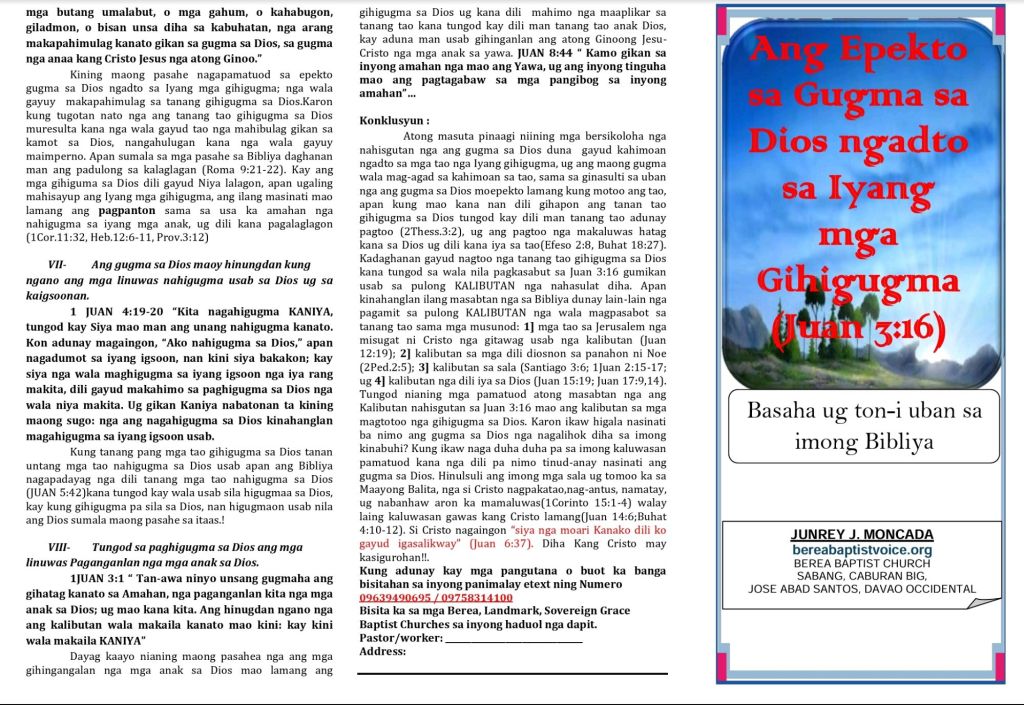
(Translated from Cebuano tract since 2013)
Junrey J Moncada
Pastor of Berea Baptist Church, Sabang, Caburan Big, Jose Abad Santos, Davao Occidental, Philippines
INTRODUCTION:
One of the greatest theological distortions of our time is the redefinition of the love of God.
Today, “God loves you” is preached as if it means:
God is trying
God is hoping
God is offering
God is waiting
God may ultimately fail
A love that desires salvation but cannot secure it. A love that gives the Son yet leaves multitudes under wrath. A love that bleeds at the cross but watches helplessly as sinners perish.
That is not the love revealed in Scripture.
That is a weakened, sentimentalized version—shaped more by modern emotion than by biblical revelation.
As the Cebuano treatise “Ang Epekto sa Gugma sa Dios” rightly asks:
“Can it be that God’s love is only in word and not in deed? Far from it! And can it also be that God’s love has no purpose and result/effect because it depends on whether man will also love God?”
The answer is clear: God’s love accomplishes what it intends.
I. GOD’S LOVE DRAWS—IT DOES NOT BEG
The LORD hath appeared of old unto me, saying, Yea, I have loved thee with an everlasting love: therefore with lovingkindness have I drawn thee.
— Jeremiah 31:3
Because He loved—therefore He drew.
The drawing is the result of the loving. God’s love is causative, not reactive. It accomplishes what it intends.
An everlasting love that fails eternally is not everlasting love—it is frustrated desire.
“This text shows that God draws those He loves, not because of man’s own effort, for man absolutely cannot come to Christ unless he is drawn by God. ‘NO ONE CAN COME to Me unless he is drawn by the Father who sent Me…’ (John 6:44)”
God’s love is effective, not ineffective. It does not merely make salvation possible—it secures it.
II. GOD’S LOVE IS POURED—NOT MERELY PROPOSED
And hope maketh not ashamed; because the love of God is shed abroad in our hearts by the Holy Ghost which is given unto us.
— Romans 5:5
Poured out.
Not suggested. Not presented. Not made available pending human permission.
Poured into the heart by the Spirit of God.
And this poured-out love results in justification and reconciliation (Rom. 5:9–10). The chapter does not end in uncertainty—it ends in salvation from wrath.
Now if all people in this world were loved and died for by Christ, then all people would surely be saved!”
The logic is inescapable:
If Christ died for someone, that death accomplishes salvation.
If God loves someone with saving love, that person will be saved.
The cross is not a failed offer—it is a finished work.
III. GOD DIRECTS THE HEART
And the Lord direct your hearts into the love of God, and into the patient waiting for Christ.
— 2 Thessalonians 3:5
This language does not suggest mere assistance, but divine direction. The heart is not portrayed as autonomously steering itself toward God, nor as standing in neutral independence, waiting for human choice to decide. Rather, the Lord Himself actively directs the heart into His love.
This destroys the notion of autonomous free will in matters of salvation. If the Lord must direct the heart, it follows that the heart, left to itself, would not move toward God.
The direction is not hypothetical but effectual, God does not merely point the way; He brings the heart into it. His sovereignty governs not only the external call of the gospel, but the internal movement of the soul.
Thus, the love of God is not dependent upon the sinner’s initiative, but the sinner’s response is the result of God’s sovereign direction. The heart does not generate love for God from its own natural power; it is brought into that love by divine operation. This confirms that salvation rests not upon human neutrality or self-determination, but upon the sovereign and effective grace of God, who directs, inclines, and secures the hearts of His people.
IV. GOD’S LOVE PRODUCES THE RESPONSE
We love him, because he first loved us.
— 1 John 4:19
His love is the cause. Ours is the effect.
The modern view reverses this—making human acceptance the decisive factor. Scripture does not.
God’s love creates the response it demands.
“If all people were loved by God, all people would have also love God, but the Bible reveals that not all people love God (John 5:42). This is because they were not loved by God either, because if they were loved by God, then they would also love God according to this passage!”
The implications are clear:
If God loves you with saving love, you will love Him in return.
The fact that many do not love God proves they are not the objects of His saving love.
God’s love is not universal—it is particular and effective.
V. GOD’S LOVE IS THE CAUSE OF SALVATION
But God, who is rich in mercy, for his great love wherewith he loved us, Even when we were dead in sins, hath quickened us together with Christ, (by grace ye are saved;)
— Ephesians 2:4-5
“These texts show that the great LOVE of God is the cause of our salvation. Even when we were dead in sin, He made us alive together with Christ, and this is called grace to the undeserving or love for the unlovely.”
The sequence is critical:
God loved us
While we were dead in sin
He made us alive
We are saved by grace
This is not conditional love. This is not God waiting for dead sinners to respond. This is resurrection love—love that brings life to the dead.
“Now if we apply these texts to all people, then it would also become that all people would be saved and made alive in Christ, and that would mean no one would perish in the lake of fire in hell—Cain, Pharaoh, Herod, the Man of sin and all who rejects Christ even satanists, would be saved if that were so? But far from it! Because God has mercy on whom He wills to have mercy and hardens whom He wills to harden (Romans 9:16-18).”
The conclusion is unavoidable:
God’s saving love is particular, not universal.
If God loved all in the same saving way, all would be saved.
Since all are not saved, God’s love must be discriminating and effectual.
* Dr. Flowers has objection by citing Matt. 5:44″Love your Enimies”-

“If God’s command to love enemies means He must love them in exactly the same way He loves His own people, then would God also be obligated to save His own arch-enemy—Satan? Such a conclusion is absurd and exposes the false assumption behind the argument.
Loving one’s enemies does not mean granting them the same love, favor, or saving grace reserved for one’s own family. If a man’s family were murdered, his refusal to take revenge against the murderer could be called a form of love—yet no rational person would conclude that he loves the murderer in the same way he loves his murdered family. Justice, mercy, and love operate in different ways according to relationship and purpose.
Therefore, God is not a hypocrite for commanding love toward enemies while reserving His saving love for His people. There is a clear distinction between showing benevolence toward enemies and bestowing covenantal, redeeming love upon His elect. Confusing these categories creates contradiction where none exists.”
VI. GOD’S LOVE IS THE CAUSE OF ELECTION
According as he hath chosen us in him before the foundation of the world, that we should be holy and without blame before him in love: Having predestinated us unto the adoption of children by Jesus Christ to himself, according to the good pleasure of his will,
— Ephesians 1:4-5
“This verse declares that God through His Love chose us to become His adopted children. And this choosing by God brings man TO LIVE holy and blameless lives, and not because they were already serving and holy beforehand to be chosen.”
The order is crucial:
God loved
God chose
Therefore we become holy
Not:
We became holy
Therefore God chose us
God’s love precedes and produces holiness—it does not respond to it.
VII. GOD’S LOVE REMOVES SIN
“To Him who loved us and has freed us from our sins by His blood.”- -Revelation 1:5
“If we reflect on this passage and apply it to all people, then all people would truly be freed from sin and would surely be saved, but still many will be judged to punishment, dying in their own sins (John 8:21,24, Rev. 20:15, Matthew 25:41).”
The argument is airtight:
If God’s love frees from sin, then those He loves are freed.
If all were freed from sin, none would perish.
Since many perish, not all are loved with saving love.
VIII. NOTHING CAN SEPARATE GOD’S LOVED ONES FROM HIM
Romans 8:35-39
“Who shall separate us from the love of Christ? …I am persuaded that neither death nor life, nor angels nor principalities, nor things present nor things to come, nor powers, nor height nor depth, nor any other created thing, shall be able to separate us from the love of God which is in Christ Jesus our Lord.”
“This passage testifies to the effect of God’s love upon those He has loved; that absolutely nothing can separate those loved by God. Now if we allow that all people are loved by God, this would result in no one being separated from God’s hand, meaning no one would go to hell.”
The logic is inescapable:
If God loves you with the love described in Romans 8, nothing can separate you.
If all were loved this way, none would be lost.
Since many are lost, this love is not universal.
“Because those loved by God will absolutely not be destroyed by Him, but if His loved ones err, what they will experience is only discipline, like a father who loves his children, and not destruction (1 Cor. 11:32, Heb. 12:6-11, Prov. 3:12).”
God’s love disciplines—it does not damn.
IX. JOHN 3:16 IS NOT A FAILED OFFER
John 3:16 is often quoted as if it proves universal, resistible love:
“For God so loved the world that He gave His only begotten Son…”
Yes—He gave.
But why did He give?
Paul answers (Romans 5:9):
“Having now been justified by His blood, much more shall we be saved from wrath through Him.”
The giving of the Son secures justification.
Justification secures salvation from wrath.
The cross is not a sentimental gesture. It is a substitutionary accomplishment.
If Christ’s blood justifies, those justified will be saved.
The love that gave the Son is the love that saves from wrath.
“Many truly believe that all people are loved by God because of their misunderstanding of John 3:16, also because of the word WORLD written there. But they need to understand that in the Bible there are different uses of the word WORLD that don’t mean all people without exception. “
The lists biblical uses of term “world”:
The people of Jerusalem who met Christ (John 12:19)
The world of the ungodly in Noah’s time (2 Peter 2:5)
The world of sin (James 3:6; 1 John 2:15-17)
The world that is not God’s (John 15:19; John 17:9,14) and The world that will be damn (1Corinthian 11:32)
“Because of these proofs, we can understand that the World mentioned in John 3:16 is the world of believers who are loved by God.”
John 3:16 does not teach universal love that fails.
It teaches particular love that saves.
X. THE REAL ISSUE
The real issue is this:
Do we believe God’s love merely makes salvation possible?
Or do we believe God’s love actually saves?
The Bible presents a love that:
Draws (Jeremiah 31:3)
Pours (Romans 5:5)
Directs (2 Thessalonians 3:5)
Produces (1 John 4:19)
Justifies (Romans 5:9)
Saves from wrath (Romans 5:9-10)
Elects (Ephesians 1:4-5)
Frees from sin (Revelation 1:5)
Makes alive (Ephesians 2:4-5)
Never loses its object (Romans 8:35-39)
A love that leaves its object eternally condemned is not the love described in Jeremiah 31, Romans 5, Ephesians 2, or 1 John 4.
To preach a love that tries but does not secure is to diminish the power of the cross.
CONCLUSION:
THE CHALLENGE
“Now, friend, have you experienced God’s love operating in your life? If you are still doubting your salvation, this is proof that you have not truly experienced God’s love yet. Repent of your sins and believe in the Good News, that Christ became man, suffered, died, and rose again so that you might be saved (1 Corinthians 15:1-4). There is no other salvation except in Christ alone (John 14:6; Acts 4:10-12). Christ says, ‘he who comes to Me I will by no means cast out’ (John 6:37). In Christ there is assurance‼”
Final Word:
God’s love is not frustrated.
God’s love is not uncertain.
God’s love does not fail.
It accomplishes redemption.
To those who have experienced the effectual call of God, who have been drawn by the Father, who have had God’s love poured into their hearts, who have been made alive when they were dead—there is assurance in Christ.
Not because of the strength of your faith, but because of the power of God’s love.
A love that secures what it seeks.
A love that saves whom it loves.
A love that cannot fail.
 Berea Baptist Voice Ph